AI Isn’t Replacing Humans. It’s Replacing Humans Who Don’t Adapt.
The AI Paradox: Are We Engineering Our Own Obsolescence or Empowering a New Era of Human Ingenuity?
It is hitting the labor market “like a tsunami.” That is how International Monetary Fund Managing Director Kristalina Georgieva described the impact of artificial intelligence at the World Economic Forum in Davos. For millions of workers, this is not hyperbole; it is a daily reality fraught with anxiety. The headlines are relentless, filled with stories of AI-driven layoffs and predictions of mass job displacement. The fear is palpable, and it is growing.
According to a 2026 Mercer report, employee concerns about job loss due to AI have skyrocketed from 28% in 2024 to 40% in 2026. Another report found that 52% of U.S. workers now fear job displacement due to artificial intelligence—nearly double the previous year . This anxiety is not unfounded. Some companies have already begun citing AI as a reason for restructuring, a practice some analysts are calling “AI redundancy washing”.
This creates a profound paradox. On one hand, AI promises unprecedented gains in efficiency and innovation. On the other, it threatens the very foundation of our workforce and, as some research suggests, our cognitive abilities. This article confronts this tension directly, exploring the valid fears surrounding AI while charting a course for a future where technology serves to augment, not automate, our humanity.
The Hidden Cost: Is AI Dulling Our Minds?
Beyond the immediate fear of job loss lies a more subtle, long-term risk: the potential for cognitive decline. As we increasingly “offload” thinking to intelligent systems, are we inadvertently engineering our own obsolescence? A recent study from the MIT Media Lab warns that an “excessive reliance on AI-driven solutions” may contribute to “cognitive atrophy” and a shrinking of our critical thinking abilities .
Experts across disciplines echo this concern. The danger lies in using AI as a crutch rather than a tool. If we allow AI to do our thinking for us—to write our first drafts, to generate all our ideas, to make our decisions—we risk losing the very skills that make us uniquely human. As Harvard Senior Research Fellow Christopher Dede cautions, simply using AI to do the same old things better and quicker can become a “faster way of doing the wrong thing” .
“Machines calculate and they do not have human experiences. ... AI can tell you how to put things together, but AI would not be able to help you build a device that relates to a human context.”
— Fawwaz Habbal, Senior Lecturer, Harvard John A. Paulson School of Engineering and Applied Sciences
This is the critical distinction. AI operates on data and statistics; humans operate on experience, context, and meaning. To thrive in the age of AI, we must double down on these irreplaceable human capacities, not outsource them.
The Collaboration Imperative: Augmentation Over Automation
The narrative of AI versus human is a false dichotomy. The most forward-thinking leaders understand that the future is not about replacement, but collaboration. The goal is not automation, but augmentation.

A groundbreaking 2025 study from the MIT Center for Collective Intelligence analyzed over 100 studies on human-AI collaboration and delivered a nuanced but powerful conclusion: while AI-human teams don’t always outperform the best AI-only system, the combination is most powerful in tasks that require human expertise and creativity.
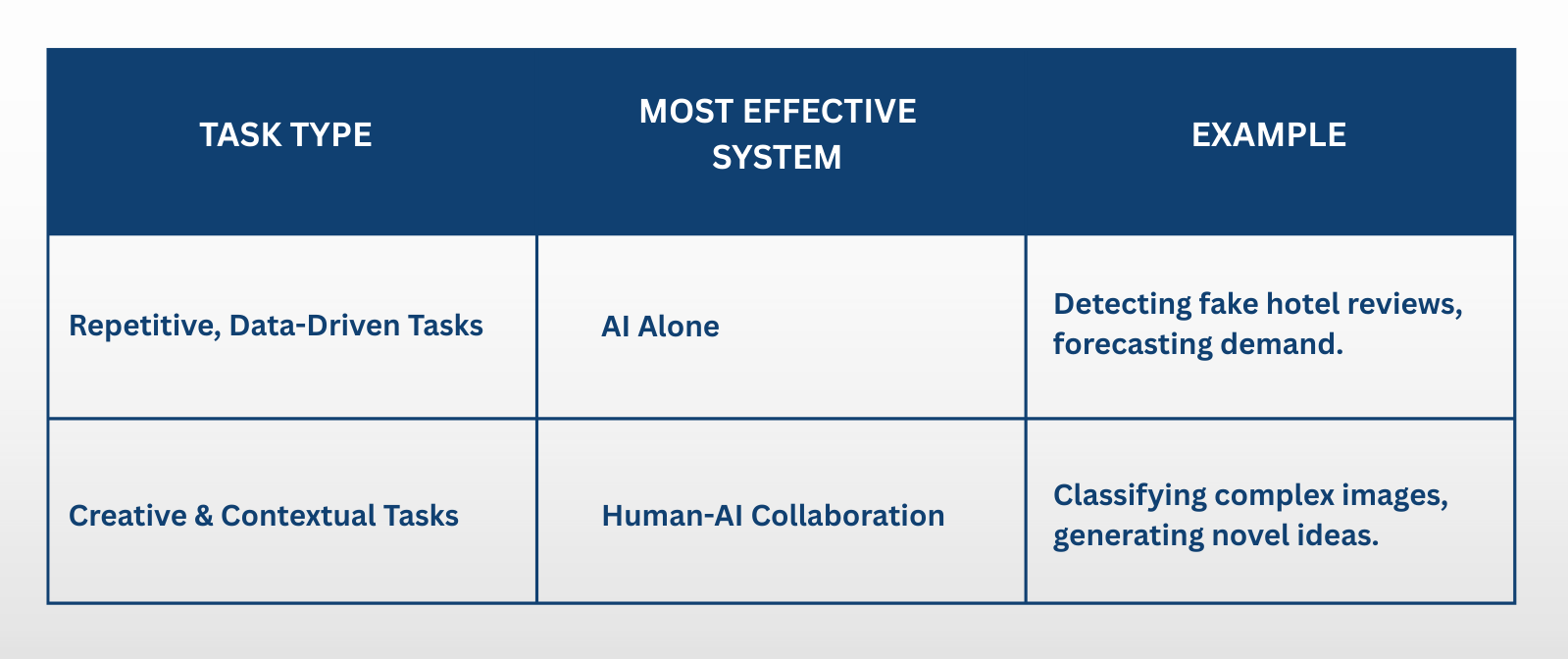
In tasks where humans already excel, such as those requiring specialized expertise or contextual understanding, the combination of human and AI achieves synergy, outperforming what either could accomplish alone. For instance, in a task classifying images of birds, human experts achieved 81% accuracy and AI achieved 73%, but the human-AI team reached 90% accuracy .
This is the model for the future of work: AI as a tool that handles the repetitive, data-intensive work, freeing up humans to focus on what we do best—critical thinking, emotional intelligence, and creative problem-solving.
The Meridian Approach: Building a Future-Ready Workforce
Navigating the AI revolution requires more than just adopting new technology; it requires a fundamental redesign of how we think about work, leadership, and human potential. This is precisely where Meridian Excellence Solutions excels. Our Integrated Performance Framework™ provides a roadmap for organizations to embrace AI not as a threat, but as a catalyst for growth and human flourishing.
Future AI Readiness & Ethical Innovation: We guide organizations in the human-centered adoption of AI, ensuring that technology is implemented in a way that expands capability, builds trust, and aligns with ethical principles. We help leaders move beyond the hype and develop a clear-eyed strategy for leveraging AI to its fullest potential.
Human Capacity & Performance Physiology: We recognize that in an AI-driven world, uniquely human skills become more valuable than ever. Our framework emphasizes the development of cognitive excellence, resilience, and decision-making—the very skills that AI cannot replicate. We know people are critical infrastructure, ensuring that your team is equipped to thrive alongside intelligent systems.
Neurodiversity & Cognitive Excellence: We design systems that optimize focus, creativity, and decision quality across diverse cognitive profiles. This ensures that as AI handles routine tasks, the full spectrum of human intelligence is unleashed on higher-order challenges.
By focusing on the intersection of human capacity and technological integration, we help organizations build a workforce that is not just prepared for the future, but is actively shaping it.
From Fear to Empowerment: A Leader’s Guide
Leaders have a critical role to play in shifting the narrative from fear to empowerment. Here are three actionable steps to guide your team through the AI transition:
Reframe the Goal from Efficiency to Augmentation. Stop talking about AI in terms of cost-cutting and start talking about it in terms of capability-building. Frame AI as a tool that will free your team from tedious work and allow them to focus on more strategic, creative, and fulfilling challenges.
Invest in Uniquely Human Skills. As AI automates routine tasks, the value of skills like critical thinking, collaboration, empathy, and creative problem-solving will skyrocket. Invest in training and development programs that cultivate these durable human skills.
Redesign Workflows, Not Just Reassign Tasks. Don’t just plug AI into your existing processes. As the MIT research suggests, the greatest gains come from fundamentally redesigning how work gets done. Empower your teams to experiment with new ways of collaborating with AI to achieve better outcomes.
The age of AI is not a dystopian future to be feared, but a new frontier of human potential to be explored. By honoring the unique capacity of the human mind and strategically integrating technology to augment our abilities, we can create a future where both companies and people thrive.
References
[1] CNBC. (2026, January 20). AI impacting labor market ‘like a tsunami’ as layoff fears mount.
[3] Harvard Gazette. (2025, November 13). Is AI dulling our minds?


